


Archiv
CW 02 2003
06.01. - 12.01.2003
The 6th of January is a holiday here as well, and everything stays very quiet.
The supermarket that's close by (2 minutes on foot) is open though, just as
on Sundays. So I use this day to do some shopping. The selection of goods
offered is huge. Apart from a large variety of fruit and vegetables (the Columbian
cuisine offer a large variety and is very healthy), they have about 40 different
kinds of freshly baked bread and fresh meat of excellent quality.
They also offer imported foods, but Columbia produces great things, for example
even a Camembert with a very nice taste. So the imported stuff, like the expensive
Swiss plum paste (that's much too sweet anyway), stay in their shelves.
| When I'm not walking (which happens quite often, due to the ideal location), I use the bus now. Taxis are very cheap (approx. 1,50 euro - 3,00 euro), but taking the bus only costs 500 pesos (about 0,20 euro) and is much more fun. The busses are run privately; by a driver and a "whipping collector". By loudly calling out the busses route the "collector" constantly tries to persuade people standing at the side of the road to use his bus. The bus takes a predetermined route during which one can get on (hand-signal) and off (calling parada) at any time. | 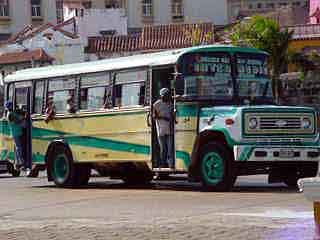 |
 |
Each bus is individually decorated and there's plenty going on inside. Men selling water jump on all the time, sweets and ice cream are sold, but you could also experience a demonstration for silver polish or a music presentation. Absolutely unique! As the name indicates, CARTAGENA DE INDIAS had quite an impressive
culture, even before the Spaniards came. New historical finds show that
the Indian culture is 2000 years older than the Mexican culture. |
| Cartagena was Spain's' major trade port. Apart form others, also for the slave trade. Enrique Grau's sculpture "The Slave of the Slaves", among others resembling San Pedro Claver, was set up in the old part of town as a reminder of those sad times. |  |
The cultural and artistic live in the city is very strong; many modern pieces of art are distributed throughout town, such as the copper statue "The Ice Seller". Its model can be seen many times in the city, scraping ice from a block, adding taste to it with fruit syrups.
 |
 |
There are a lot more beautiful things to tell you about and beautiful pictures
to show you (see an incentive at the end of this page) …
more of that next week, if you like …
until then, take care!
TOM


